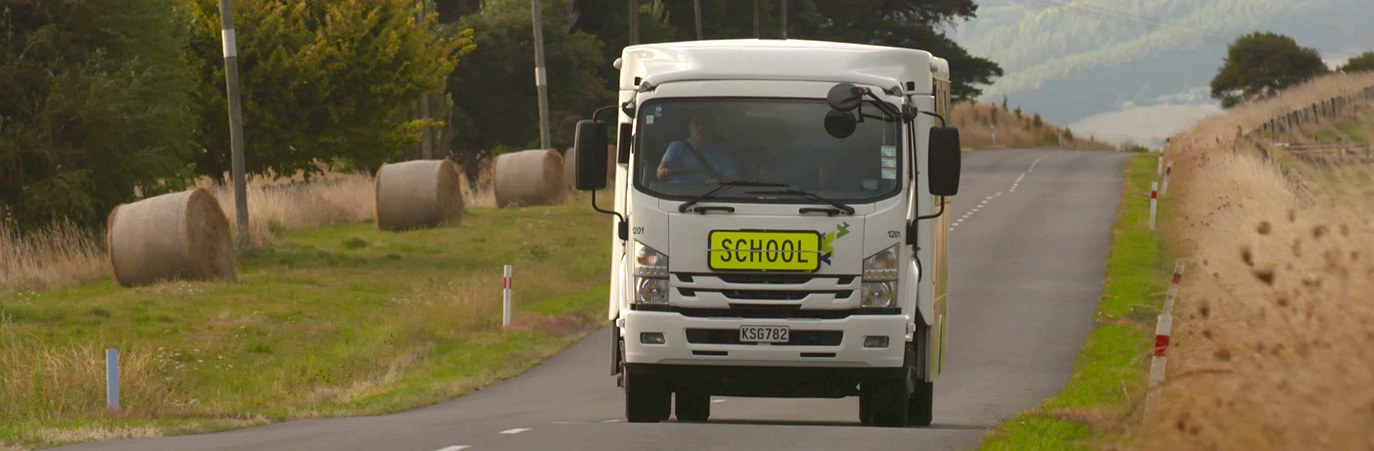
Slow Down: Our Kids Are Depending On It
Let's be blunt: most drivers do the right thing, most of the time. But it only takes one driver, on one morning, not slowing down for a school bus or a school zone to put a child's life at risk. Despite the law, despite the signage, despite years of campaigns, some drivers across the Wairarapa are still blowing past stationary school buses and through school gates at speed — and when that happens, it's only a matter of time before it costs a child their life.
We've just passed the shortest day of the year. Mornings are dark, afternoons are dim, and it will be weeks yet before the light really starts stretching out. That's exactly when complacency creeps in — when a driver assumes they can see everything, when kids in dark uniforms disappear against grey verges, when “I didn't see them” becomes the excuse after the fact instead of the warning before it. This isn't a time to point fingers at every driver on the road — it's a reminder to call out the specific behaviours that put children at risk, so we can all keep doing better.
The Law Hasn't Changed. Compliance Has to.
When a school bus is stopped to pick up or drop off children, the law requires every driver — approaching from either direction — to slow to 20km/h. Not “roughly.” Not “if you have time.” Twenty. It applies on urban streets, rural roads, and state highways alike, and it applies whether you can see a child yet or not, because the whole point is to give you time to react before you can. Most drivers already know this and do it — this is about calling out the moments when a driver doesn't, so those behaviours change.
“The vast majority of drivers do the right thing around school buses,” says Holly Hullena, Projects Coordinator at the Wairarapa Road Safety Council. “But it only takes one driver, in one moment, to ignore the 20km/h rule and put a child in danger. Slowing down isn't a suggestion — it's a legal requirement. Children are unpredictable. Slowing down gives you the time to react and prevent a tragedy.”
Now There's More: New Variable Speed Limits Outside Schools
As of 1 July 2026, the rules have expanded well beyond the school bus itself. Under the Government's Setting of Speed Limits Rule, councils across New Zealand — including here in the Wairarapa — must now have variable speed limits (VSLs) operating outside every school:
● Urban streets outside school gates: a 30km/h variable limit, extending up to 150 metres either side of the school gate.
● Rural roads outside schools: a 60km/h or lower variable limit, extending up to 300 metres either side of the school gate — directly relevant to the many rural schools across the Wairarapa where children are picked up and dropped off on higher-speed open roads.
● When they apply: these lower limits operate for up to 45 minutes either side of the start and end of the school day (schools clustered together may share a slightly longer window), and can also apply for up to 10 minutes around other times when children are gathered at the gate, such as sports days.
Not every sign works the same way. Some are electronic and flash on and off to show when the lower limit is active. Others are static signs with the school times printed directly on them — no flashing, no light-up display, just the hours stated in black and white. Either way, the rule is the same: if you're driving past during those printed or displayed times, the lower limit is legally enforceable, not advisory. Don't wait for a sign to flash at you before you slow down — check the times, and if you're in that window, treat it exactly as you would any other posted speed limit.
Why 20km/h Actually Matters — the Physics of It
This isn't just about caution for caution's sake. It comes down to basic physics.
A vehicle's stopping distance doesn't increase in a straight line with speed — it increases with the square of speed. Double your speed and you roughly quadruple the distance needed to stop. A car travelling at 50km/h needs vastly more room to stop than one travelling at 20km/h, and the energy released in a collision follows the same squared relationship. That means a crash at 40km/h isn't twice as dangerous as one at 20km/h — it's closer to four times as dangerous in terms of the force involved.
Children stepping out from behind a bus, or darting onto a rural road with no footpath, give drivers almost no warning. At 20km/h, a driver has a genuine chance to stop before impact. At 40 or 50km/h, that chance narrows dramatically — and if a collision does happen, the forces involved are far more likely to be fatal. Slowing down isn't a courtesy. It's the only thing standing between a near miss and a tragedy.
Rural Roads: Where the Risk Is Highest
A large number of Wairarapa students are picked up from rural roads — often with no footpath, no streetlights, and traffic moving at open-road speeds right up until the moment a bus indicator comes on. These are also the roads where the new 60km/h rural VSLs will make the biggest difference, but only if drivers respond to them every time. A sign only works if the behaviour behind the wheel matches it.
Drivers on rural routes need to build in the expectation that a school bus could be stopped just around the next bend, especially in the low light of these winter mornings and afternoons. Slow down early. Don't wait until you can see the bus — or wait for a sign to light up — to lift your foot off the accelerator. If it's a static sign with printed times, know the times before you drive the route, not after you've already sped through it.
Practical Advice for Drivers
● Anticipate, don't react. If you're on a route with a school bus run or a school zone, ease off before you reach it — not when you see the sign.
● Know the signs on your route — electronic and flashing, or static with printed times — and treat the lower limit as a hard limit, not a guideline, whenever you're in that window.
● Assume there's a child you can't see yet. Behind the bus, behind a hedge, behind a parked car.
● Put the phone away entirely on these stretches — a glance away is exactly the moment a child could step out.
● Build in the time. Leaving two minutes earlier costs you nothing. Hitting a child costs everything.
A Word to Parents: Do Your Part Too
Slowing traffic is only half the equation — visibility and good habits at the kerb matter just as much.
● Make sure your child is genuinely visible, especially in these darker, low-light months: light-coloured or reflective clothing, and school bags with reflective strips or covers where possible.
● Many rural schools hold stocks of reflective vests and hi-vis pack covers, funded specifically at the request of those schools to help keep children safe on the roadside. If your school has these, use them — every day, not just when it's raining.
● Reinforce the school's kerb and bus rules at home: stand well back from the road while waiting, wait for the driver's signal before crossing, and wait until the bus has driven off past two power poles before checking whether it's safe to cross.
● Talk to your kids about the why, not just the rule. Understanding that a stopped bus means “cars might not stop” is what keeps them cautious even when no adult is right beside them.
The Bottom Line
The law around school buses hasn't changed, and most drivers already follow it. But with variable speed limits now rolling out at schools right across the country, there's no excuse left for the moments when a driver doesn't. Slow down. Watch for the signs. Assume there's a child you haven't seen yet. It costs you only seconds. It could cost someone else everything.
More information:
Bus safety: https://www.education.nzta.govt.nz/teacher-resources/school-policy-and-practices/school-bus-safety
Variable Speed Limits: https://www.nzta.govt.nz/travelling-on-our-roads/safety-cameras/other-safety-infrastructure/variable-speed-limits
